


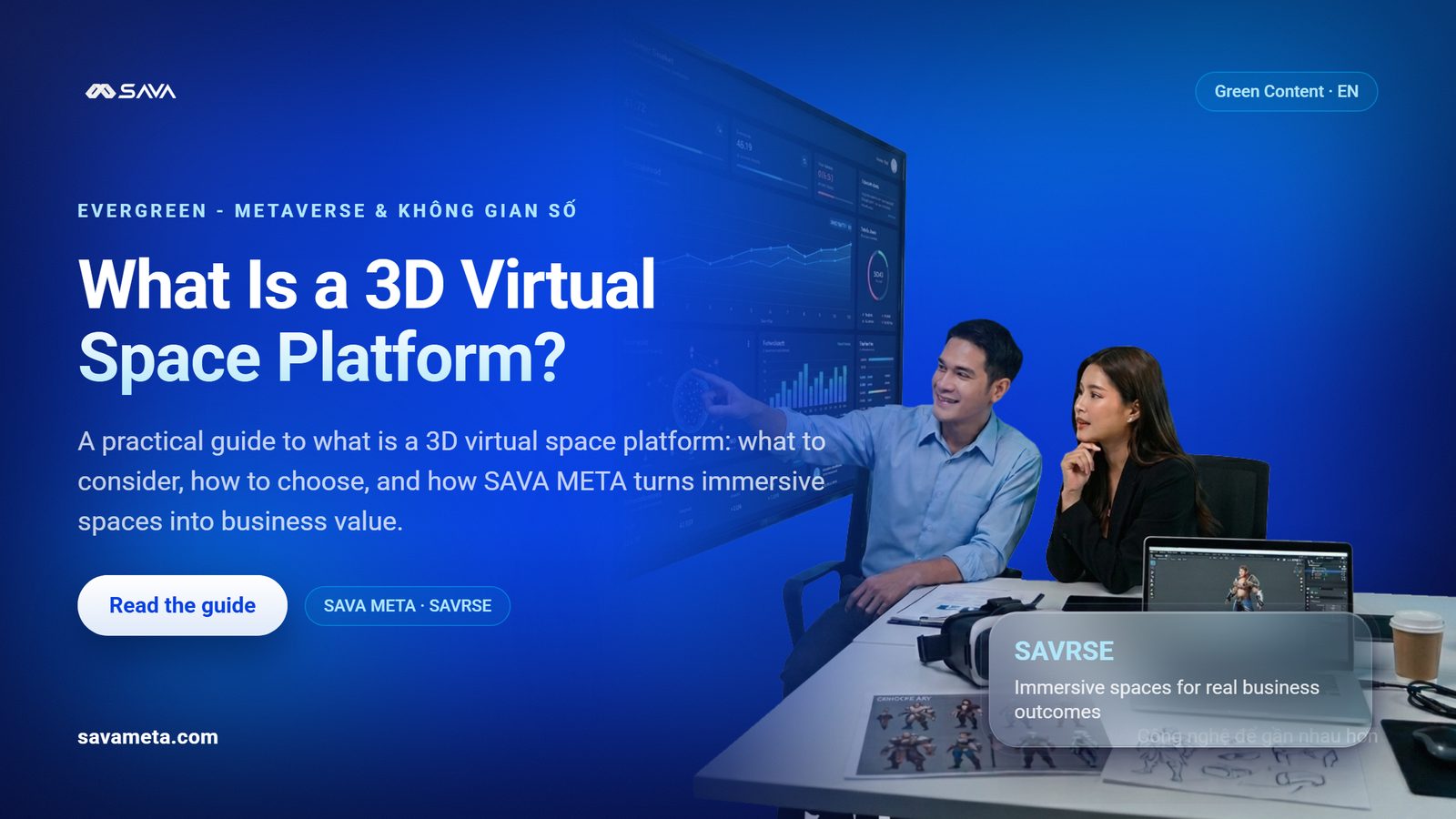
A 3D virtual space platform is software that lets people enter, move through, and interact inside a navigable three-dimensional environment from a browser, headset, or app — without installing heavy tools or understanding the technology underneath. If you have been asking what a 3D virtual space platform is because you are weighing whether to build a virtual showroom, a training environment, or a branded digital space, the short answer is this: it is the layer that turns a 3D scene into a place your customers, staff, or partners can actually visit and use. This article explains what that means in practice, where a business should start, when it is the wrong time to build one, and how SAVA META approaches the decision.

A 3D virtual space platform is a system that hosts interactive three-dimensional environments and delivers them to users over the internet, handling rendering, navigation, multi-user presence, and interaction so that a business can publish a usable digital space instead of a static file. Think of the difference between a 3D model sitting in a design tool and a showroom your customer can walk through on their phone. The model is an asset. The platform is what makes that asset a destination — it manages who is inside, what they can touch, how the space loads on a mid-range device, and how it connects back to your existing systems like a product catalog, a booking form, or a CRM.
Most platforms bundle a few core capabilities: a rendering engine that draws the 3D scene in real time, a way to move a camera or an avatar through it, hosting and streaming so large scenes load without a long wait, and hooks for interaction such as clicking a product, joining a voice room, or triggering a form. Some add multiplayer presence so several people share the same space, analytics so you can see where visitors go, and content tools so a non-technical team can update the space later. What matters is not the label “metaverse” — it is whether the platform solves the specific problem you have.
A business needs a 3D virtual space when the value depends on spatial understanding, presence, or exploration that flat media cannot carry. A photo shows a product; a video walks a viewer through a fixed path; a 3D space lets the visitor decide where to look, how close to get, and what to try — which is exactly what matters when someone is evaluating an apartment layout, learning to operate equipment, or comparing configurations of a large product.
Here are situations where a 3D virtual space earns its cost:
If your goal is served just as well by a good webpage, a configurator, or a short video, that is the honest answer — and it will cost you far less. A 3D virtual space platform is worth it when the space itself does work that flat media cannot.
Start with one specific problem and one measurable outcome, not with a platform choice. The most common mistake is to begin by asking “which engine or vendor should we use” before deciding what the space is supposed to change. Pick a single use case — a virtual showroom for one product line, an onboarding environment for one role, a booth for one event — and define what success looks like before anything gets modeled.
A workable starting sequence looks like this:
Starting small is not a lack of ambition. It is how you learn what your audience actually does inside a 3D space before you commit a budget to the full build.
It is not the right time when you cannot name the problem the space solves, when the audience has no way or reason to reach it, or when no one will own it after launch. A 3D virtual space is a product, not a campaign — it needs upkeep, and it competes for the same attention every other channel does.
Signs you should wait or choose something simpler:
Saying “not yet” is a legitimate result. It is cheaper to reach that conclusion in a planning conversation than after a build.

The process moves from problem definition to a pilot to a maintained product, with content and performance treated as first-class concerns throughout. It is not a single hand-off to a 3D team; it is a loop of building, testing with users, and refining.
A realistic build typically runs through these stages:
Performance work runs across every stage. A visually rich space that takes thirty seconds to load, or stutters on a common phone, has failed regardless of how good it looks on a workstation.
The right approach depends on who must reach the space and how much depth the experience needs. The table below compares the common delivery modes so you can match them to your audience rather than to a trend.
|
Approach |
Best for |
Reach |
Trade-off |
|
Browser-based 3D (WebGL/WebXR) |
Showrooms, product exploration, wide public access |
Highest — no install, works on most devices |
Lighter scenes; must optimize hard for mid-range phones |
|
App-based 3D |
Repeat use, richer graphics, loyal audiences |
Medium — requires a download |
Install friction reduces first-time reach |
|
VR/XR headset |
Training, simulation, high-presence experiences |
Lowest — needs hardware |
Depth and immersion at the cost of audience size |
|
Hybrid (browser + headset) |
Public reach plus a premium mode for select users |
Broad, tiered by device |
More to build and maintain across modes |
There is no single best row. A public retail showroom and an internal safety-training simulator have opposite priorities, and the platform choice should follow the audience, not the other way around.
Measure a 3D virtual space against the business outcome you defined at the start, not against how many people said it looked impressive. Vanity signals — a spike in visits at launch — fade fast and tell you little about value.
Useful measures depend on the goal, but they tend to fall into these groups:
Instrument the space so these are visible from the start. A platform that cannot tell you where people go and where they leave is a space you cannot improve.
The common mistakes are treating the space as a one-time showpiece, prioritizing visual richness over performance, and building without a real audience or owner in mind. Each of these turns an expensive build into something no one uses.

SAVA META approaches a 3D virtual space as a business problem first and a 3D project second. Before discussing engines, avatars, or environments, the starting question is what the space is meant to change — a slower sales cycle, a costly training process, a brand experience that a flat page keeps flattening. If that problem does not need a 3D space, we say so; it is a cheaper answer to give in planning than to discover after a build.
From there, our working principles are practical. We favor a small, honest pilot over a large speculative launch, because real users inside a real space teach more than any specification. We treat performance and device reach as design constraints, not afterthoughts, so the experience works for the audience you actually have — not only on a high-end workstation. We insist that a space connects to the systems that make it do business, and that someone can maintain it after we leave. Across Metaverse and interactive digital space, VR/XR, and our game and AI work, the same discipline holds: we build products and digital experiences that step into a real problem, and we measure them against the outcome you set at the start. The aim is a space people use and a team that owns it — not a demo that impresses once and then goes quiet.
No. Many 3D virtual spaces run directly in a web browser on a phone or laptop, with no headset and no download. A headset adds depth and presence and suits training or simulation, but it narrows your audience. For public-facing spaces like showrooms, browser-based access usually reaches far more people.
A game engine is a tool for building 3D content; a 3D virtual space platform is the system that hosts, delivers, and manages that content for real users over the internet. Engines are often used to create the environment, while the platform handles access, multi-user presence, streaming, and integration with your business systems.
It depends on scope, but a focused pilot — one space, one clear flow, real content — is achievable in weeks rather than months, while a large multi-space environment takes longer. Starting with a pilot is deliberate: it lets you test with real users and learn before committing to a full build.
It can, if performance is treated as a design constraint from the start. Well-optimized browser-based spaces run on mid-range phones; unoptimized, visually heavy scenes will exclude those same users. The device your audience actually carries should shape the technical choices, not the reverse.
Beyond the initial build there are ongoing costs for hosting, updates, and content upkeep, which is why ownership matters. A space is a product, not a one-off campaign. Budgeting only for the launch and not for maintenance is a common reason these projects go stale.
Yes, and it should. A 3D virtual space becomes useful when it links to your product catalog, booking, forms, analytics, or CRM, so interest inside the space turns into action outside it. Integration is what separates a working commercial space from a standalone showpiece.
If you are weighing whether a 3D virtual space fits a real problem in your business, the useful next step is a short, grounded conversation about the outcome you want — not a technology pitch. SAVA META can help you decide whether to build, what to pilot first, and how to measure it. Reach us at [email protected] to talk through your use case.
Bài viết liên quan