


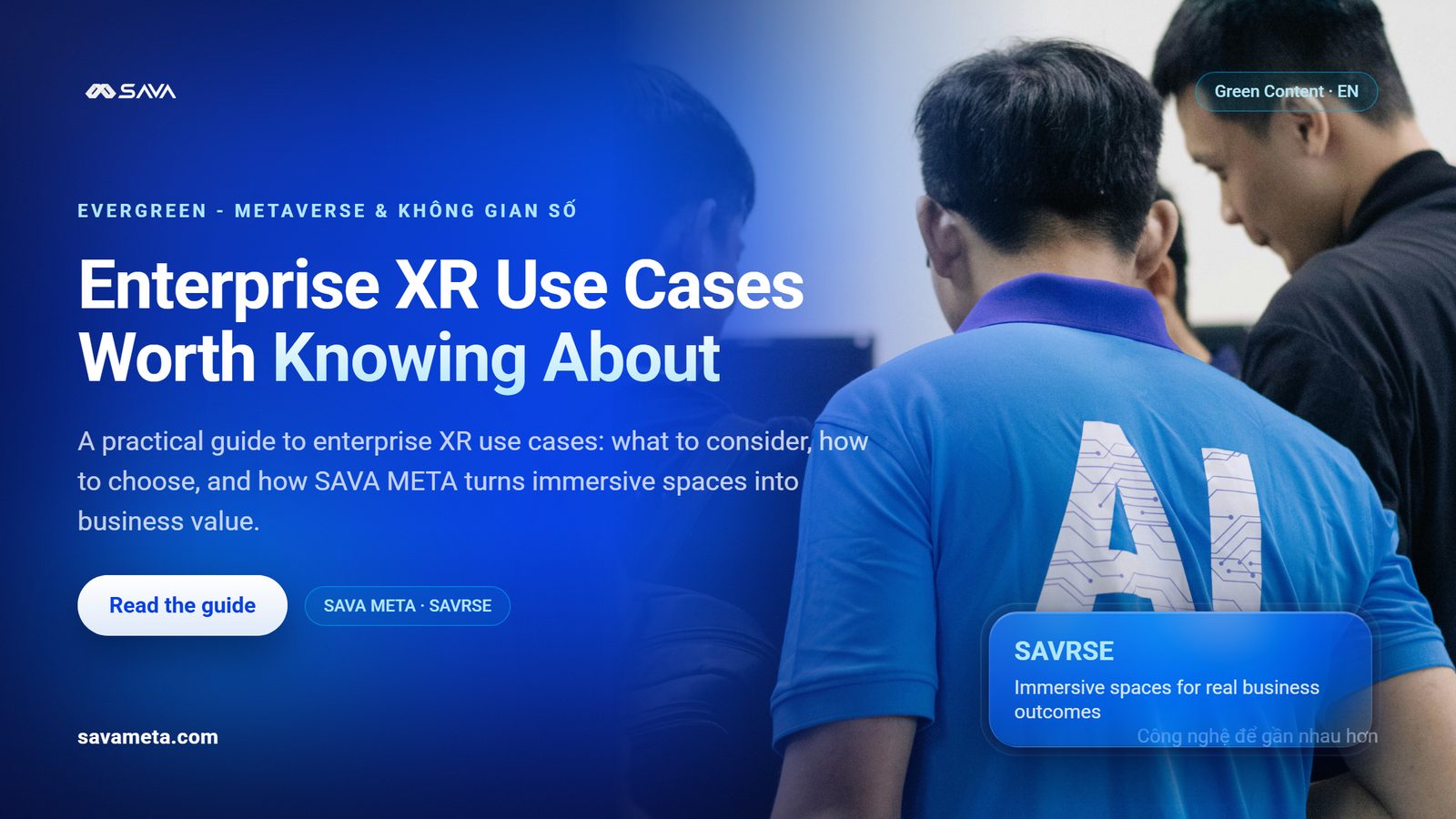
If you are weighing whether extended reality belongs in your operation, the enterprise XR use cases worth knowing about are the ones tied to a measurable business problem: training people faster and more safely, letting distributed teams inspect the same 3D model, guiding technicians through complex procedures, and letting customers experience a product before it physically exists. These are not futuristic demos. They are working tools inside factories, showrooms, hospitals, and design studios today. The question for most companies is not whether XR is impressive, but which specific use case pays for itself and where to begin.

Enterprise XR is the business use of extended reality technologies — virtual reality (VR), augmented reality (AR), and mixed reality (MR) — to solve operational problems rather than to entertain. Where consumer XR aims at games and social experiences, enterprise XR is measured against outcomes a CFO recognizes: shorter training time, fewer errors, lower travel cost, faster design cycles, and higher conversion. The hardware ranges from standalone headsets to phone-based AR and tethered high-fidelity systems, but the defining trait is that the experience sits inside a real workflow and produces data you can act on.
It helps to keep the three layers straight. VR replaces your view of the world with a simulated one, which suits training and design review. AR overlays digital information onto what you already see, which suits field service and guided assembly. MR anchors interactive 3D objects into physical space so you can walk around them, which suits collaborative planning. Most practical enterprise XR use cases pick one layer deliberately rather than trying to do all three at once.
The strongest enterprise XR use cases share one quality: the physical alternative is expensive, dangerous, slow, or impossible. When those conditions are absent, a video or a web app usually does the job for less money. The clusters below repeatedly earn their keep:
Notice what these have in common: each one removes a concrete cost or risk. That is the filter to apply before you count any use case as worth knowing about.
Start with a single, painful, repeatable process — not with the technology. The most common failure is buying headsets first and then hunting for a problem to justify them. Reverse that order. Look for a workflow where the current method is demonstrably costing you time, money, or safety, and where the failure is frequent enough that improvement compounds.
A workable starting point usually meets most of these criteria:
Run one pilot against one process, instrument it properly, and let the numbers decide whether to expand. A narrow win you can defend beats a broad rollout no one can measure.
XR is the wrong call when a cheaper, flatter tool solves the same problem just as well. Extended reality carries real costs — hardware, content production, device management, and change management for the people who have to use it — so it should only enter where those costs are justified by the difficulty of the alternative. Some honest disqualifiers:
Naming these conditions out loud is part of doing the work responsibly. A partner who tells you when to wait is more useful than one who sells you a headset for every problem.

Delivering an enterprise XR project is closer to product development than to buying software off a shelf. The path runs from a defined problem to a measured result, with content and integration as the heavy middle. In practice it moves through these stages:
Measure XR the way you would measure any operational change: against a baseline, on metrics that connect to money or risk. Vanity numbers like session counts tell you nothing about value. The metrics that matter depend on the use case, and it helps to see how they line up:
|
Use case |
Primary metric |
What it replaces |
|
Safety and skills training |
Time to competency; error rate; incident rate |
Classroom time and risky live practice |
|
Remote expert assistance |
First-time fix rate; travel cost avoided |
Specialist travel and repeat visits |
|
Design and engineering review |
Design errors caught before build; review cycle length |
Physical prototypes and late rework |
|
Guided assembly and maintenance |
Task completion time; defect rate |
Paper manuals and error correction |
|
Sales and configuration |
Conversion rate; time to decision |
Physical showroom stock and slow quoting |
Pick one primary metric per use case, capture the baseline before you deploy, and hold the pilot to that number. If the improvement is real, it will show up there.
Most enterprise XR projects fail for organizational reasons, not technical ones. The technology is mature enough; the discipline around it often is not. The recurring mistakes are predictable:
SAVA META approaches enterprise XR by starting from the business problem and working backward to the technology, never the other way around. We treat XR as one option among several, and we say so plainly when a simpler tool would serve you better. Our teams work across Metaverse and interactive digital space, VR/XR, game production, and AI, which means we can build the 3D content, the interaction logic, and the data integration under one roof rather than stitching together vendors who do not talk to each other.
In practice, that approach looks like this:
The game production heritage matters here. Building interactive 3D worlds that people actually enjoy using is a craft, and it carries directly into enterprise experiences that hold a trainee’s attention or make a technician’s job genuinely easier.
Not always. Many valuable use cases run on affordable standalone headsets or even phone-based AR. The right hardware follows from the use case and the environment, so the device decision comes after the problem is defined, not before. Hands-free field work, high-fidelity design review, and light training each point to different price points.
A focused pilot on a single, well-defined process typically runs a few months from framing to measured result, with 3D content production as the largest variable. Broad, multi-scenario builds take much longer, which is exactly why we recommend starting narrow. A tight scope is what makes a first project finishable and evaluable.
No. While manufacturing and field service are common starting points, the same logic applies to healthcare training, real estate and property sales, retail configuration, and design firms. The deciding factor is whether the physical alternative is expensive, risky, or slow — not the size of the company.
Enterprise XR refers to the practical business use of VR, AR, and MR to solve specific problems, while the metaverse describes persistent, shared virtual spaces more broadly. Enterprise XR use cases are narrower and outcome-driven; they borrow the same underlying 3D and spatial technology but are judged by operational results rather than by openness or scale.
You scale what the data supports and keep measuring. Success means a defensible improvement on your chosen metric, which becomes the case for expanding to more sites, teams, or scenarios. The post-launch work — updating content, managing devices, and supporting users — moves from plan to ongoing operation.
Yes, and it usually should. The value often comes from wiring the experience into CAD models, learning management records, service ticketing, or product catalogs so it reflects live data rather than a static demo. That integration is part of a serious build, and it is one reason having 3D, interaction, and data expertise together matters.
If you have a process that is expensive, risky, or slow because it happens in the flat world when it belongs in three dimensions, that is where an enterprise XR conversation earns its place. SAVA META can help you qualify the use case, scope an honest pilot, and build the experience and the integration behind it. Reach us at [email protected] to talk through the specific problem you are trying to solve — and we will tell you plainly whether XR is the right tool for it.
Bài viết liên quan