


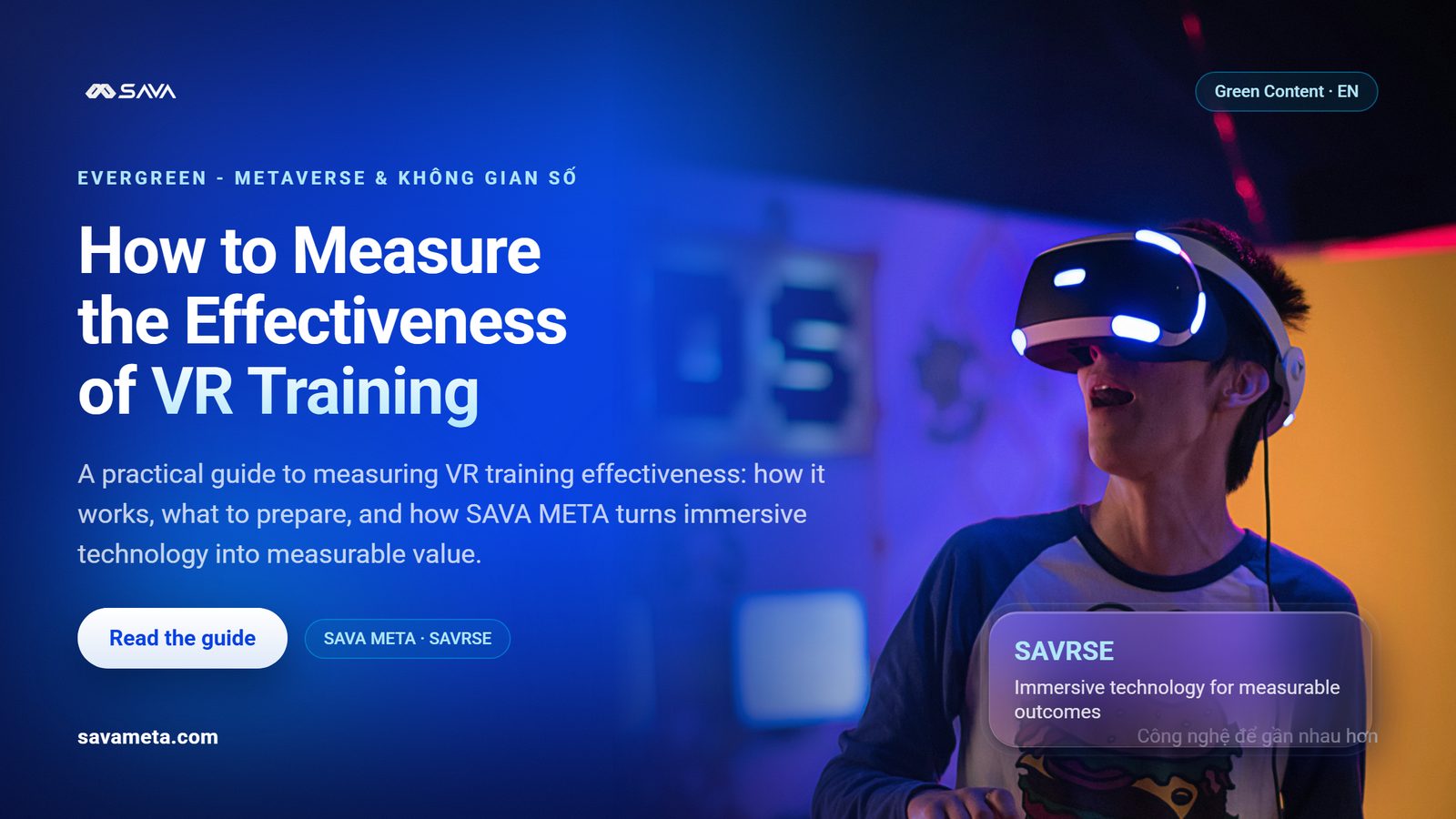
Measuring VR training effectiveness starts with one honest question: did people change how they perform on the job after the headset came off? You measure it by defining the behavior or skill you wanted to move before you build anything, then tracking a small set of signals — completion and pass rates, time-to-competency, error rates during and after training, on-the-job performance, and cost per trained employee — against a baseline. VR gives you a rich stream of in-headset data most classroom or e-learning formats never capture, but that data is only useful when it is tied to a business outcome you agreed on up front. The rest of this article walks through what to measure, when the numbers are misleading, and how to avoid mistaking “people enjoyed it” for “people got better.”
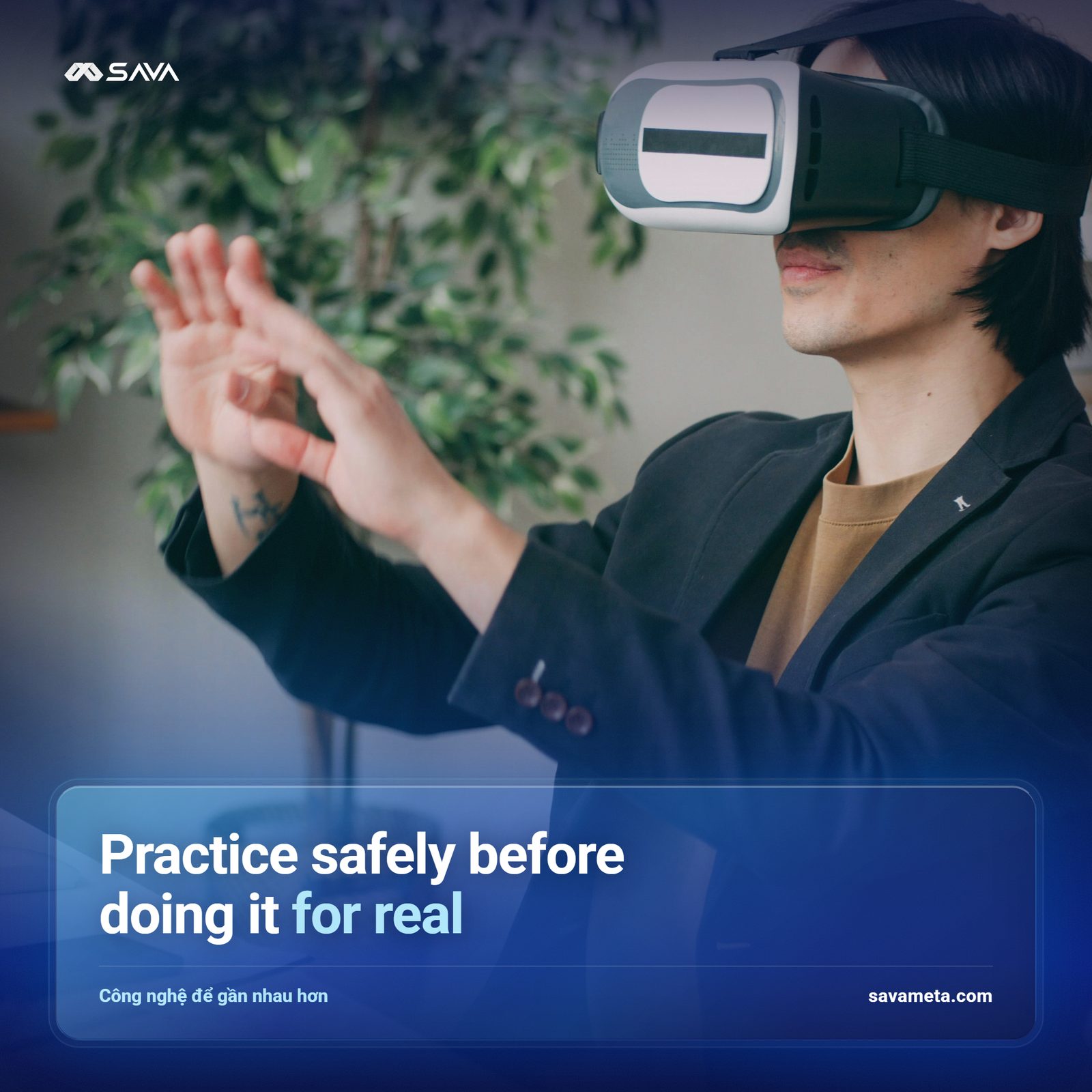
VR training effectiveness is the degree to which a virtual reality learning experience produces a measurable improvement in knowledge, skill, confidence, or on-the-job behavior, relative to the goal it was built for and the cost of delivering it. It is not the same as engagement, immersion, or how impressed a trainee felt. A program can be visually convincing and still fail to change performance; another can look plain and cut error rates in half. Effectiveness is the second thing — the change in outcome — and it is what a business is actually paying for.
Two ideas sit underneath this definition. The first is the baseline: you can only claim an improvement if you know what performance looked like before. The second is transfer: the point of training is that the learned behavior shows up in the real environment — on the factory floor, in the operating room, at the customer counter — not just inside the simulation. Everything in measuring VR training effectiveness is an attempt to prove, with evidence, that transfer happened.
VR is hard to measure because it produces a flood of activity data that looks like insight but often is not. A headset can record where a trainee looked, how long each step took, which hand reached for which tool, how many attempts a task needed, and dozens of other traces. It is tempting to report all of it. But raw activity answers “what did they do in the sim?” — not “are they better at the job?” Confusing the two is the most common failure in VR measurement.
Three factors make this genuinely difficult:
None of this means VR can’t be measured. It means the measurement has to be designed on purpose, before the content is built, not bolted on afterward.

Measure a small, layered set of metrics that move from “inside the headset” to “on the job,” because effectiveness only counts once it reaches real work. A useful frame is four levels: reaction, learning, behavior, and results. Reaction is the weakest signal and results is the strongest, so weight your reporting accordingly.
For most programs, a strong core scorecard looks like this: time-to-competency, error rate (in-sim and on-the-job), pass rate against a defined standard, retention measured by a delayed re-test, and cost per trained employee. Five well-chosen numbers beat fifty vanity metrics. If a metric can’t be tied back to a decision someone will make — retrain, certify, redesign, scale — it probably doesn’t belong on the report.
You measure results by comparing against something — a baseline, a control group, or a prior method — because a number with nothing to compare it to proves nothing. The cleanest approach is a before-and-after design with a comparison cohort, run over enough time to see whether the effect holds.
A practical sequence:
You will rarely get a laboratory-perfect experiment inside a working business, and that’s fine. The goal is a defensible comparison, not a published study. Even a simple baseline-versus-after view, run honestly, tells you far more than a glossy dashboard of in-headset activity.

It’s too early to trust the numbers when you only have a single session, a single cohort, and no delayed measurement. Early VR data is the least reliable data you will ever collect, because novelty, small samples, and enthusiasm all push it upward. A few situations where you should hold off on strong conclusions:
Naming these limits out loud is a strength, not a weakness. It’s what separates a measurement you can defend to a finance team from a number you’re hoping no one questions.

SAVA META approaches measurement as part of the build, not a report generated after it. We start from the business problem — a safety incident rate that’s too high, onboarding that takes too long, a procedure that’s expensive to get wrong — and we agree with the client on the single outcome the training exists to move before a scene is designed. That outcome becomes the measurement spec, and the scenario, the scoring logic, and the in-headset data capture are all designed backward from it.
In practice that means we instrument the experience deliberately: the moments that matter for competency are the moments we log, so the data maps to the pass standard rather than drowning it. We build the baseline capture into the rollout plan, define the competent-versus-not threshold with the people who actually own the job, and schedule the delayed re-test from the start so retention is measurable rather than assumed. We also try to keep the metric set small and tied to decisions — certify, retrain, redesign, scale — because a scorecard nobody acts on is just decoration.
SAVA does not position VR as automatically better than a classroom. For some content it clearly is — high-consequence, hard-to-rehearse, physically situated tasks are where learning by doing pays off. For others, a video and a checklist are cheaper and just as effective, and we’ll say so. The point of stepping into the problem first is that it keeps us honest about when the simulation earns its cost and when it doesn’t.
The most common mistake is measuring what’s easy to collect instead of what proves the program worked. VR makes activity data abundant, so teams report the abundance and skip the outcome. Other recurring errors:
Different measurement signals cost different amounts and prove different things. Choosing well means matching effort to the decision you need to make.
|
Signal |
What it tells you |
Effort to collect |
Strength of evidence |
|
Reaction / satisfaction survey |
Whether learners liked it and felt more confident |
Low |
Weak |
|
In-headset performance data |
How they performed inside the simulation (attempts, errors, time) |
Low once built |
Moderate |
|
Pre/post knowledge & skill test |
Learning gain against a defined standard |
Medium |
Strong |
|
Delayed re-test |
Whether the skill was retained |
Medium |
Strong |
|
On-the-job behavior & results |
Whether it changed real work outcomes |
High |
Strongest |
A sensible program uses several rows together: cheap signals for context and frequency, expensive signals for the claims that reach a budget meeting.
Learning gains show immediately in a post-test, but real effectiveness needs a delayed re-test two to eight weeks out and an on-the-job outcome tracked over one to three months. Immediate results alone tend to overstate the effect because of novelty, so plan for a measurement window that extends past the training session itself.
No. In-headset data shows how someone performed inside the simulation, which is a moderate signal at best. To prove effectiveness you need it tied to a defined pass standard and, ideally, to on-the-job behavior or a business result. Activity data is a useful input, not a conclusion.
Engagement is how involved or satisfied a learner felt; effectiveness is whether their performance actually improved. They often move together but not always — people enjoy experiences that teach them little and dislike ones that teach them a lot. Measure both, but never let engagement stand in for a result.
A control group makes your evidence stronger, but it isn’t always practical inside a running business. A clean before-and-after baseline, run over enough cohorts and with a delayed re-test, is usually defensible on its own. Use a comparison group when you can, and be honest about the limits when you can’t.
Divide total program cost — content build, hardware, facilitation, maintenance — by the number of employees trained to get cost per trained employee, then set that against the outcome each method produces. VR often has a higher upfront cost that amortizes across more trainees, so compare over the full expected lifetime, not the first cohort.
Start with a baseline of your current outcome and a clear pass standard. Those two things cost little and make every later metric interpretable. Without them, even sophisticated data can’t tell you whether anything improved.
If your team is planning VR training and wants a measurement approach you can defend to operations and finance — not just a demo — SAVA META can help design the scenario, the scoring, and the data capture around a single outcome that matters. Tell us the problem you’re trying to move, and we’ll tell you honestly whether VR is the right way to move it. Reach us at [email protected] to scope a pilot with measurement built in from day one.
Bài viết liên quan