


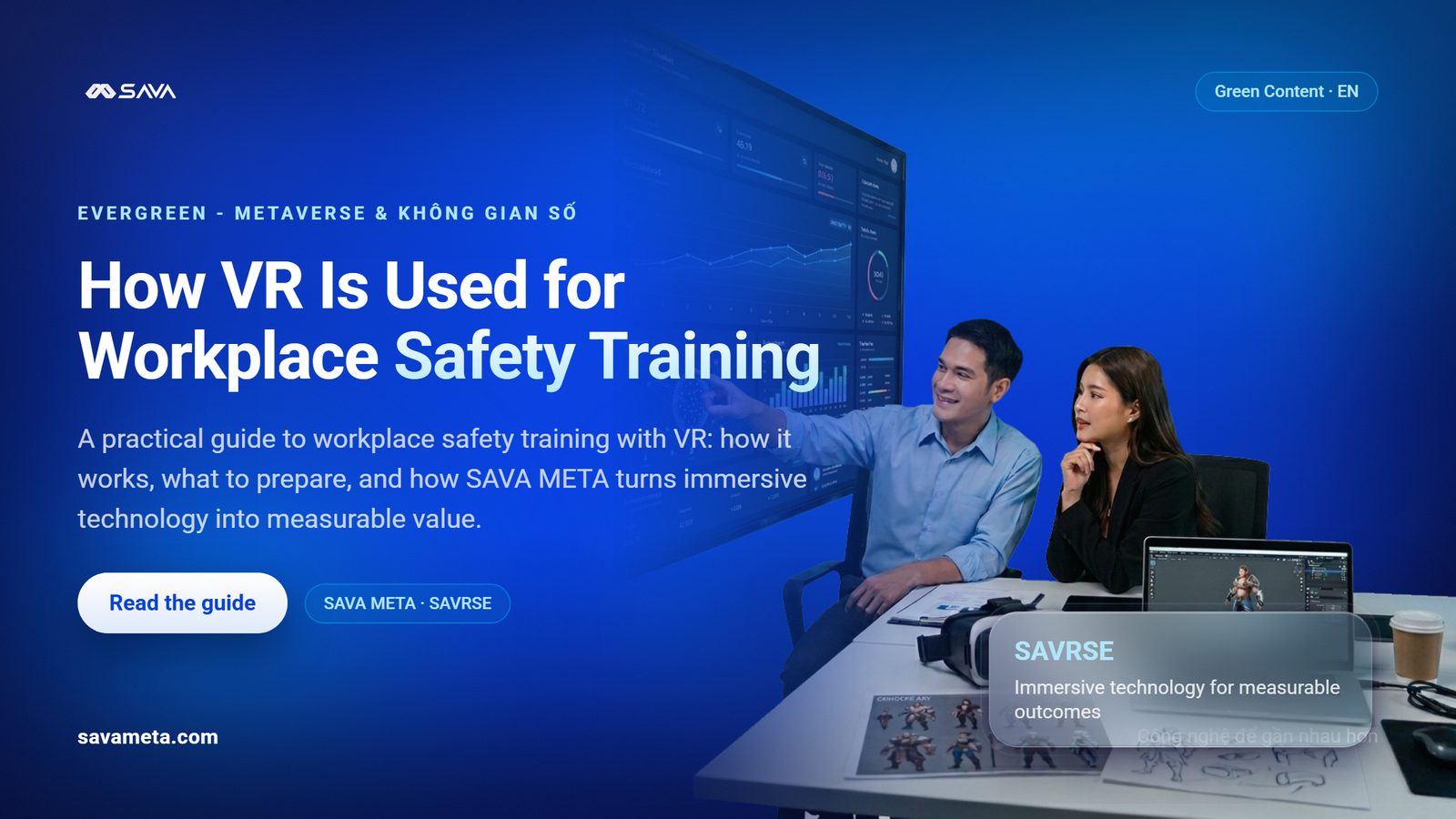
VR is used for workplace safety training by putting employees inside a realistic, controlled simulation of a hazardous situation — a fire, a fall risk, a chemical spill, a machine lockout — so they can practise the correct response with their hands and eyes, not just read about it on a slide. In practice, workplace safety training with VR replaces the passive slideshow-and-quiz format with a repeatable drill: the worker moves through the scene, makes decisions, sees the consequences of a wrong move, and repeats until the safe behaviour becomes automatic. It matters most for high-risk, low-frequency events — the emergencies that are too dangerous, too expensive, or too rare to rehearse for real.
Workplace safety training with VR is a method of teaching safety procedures inside a computer-generated 3D environment that the trainee experiences through a headset, where the scenario responds to their actions. Instead of watching someone else demonstrate a procedure or answering multiple-choice questions, the employee stands in a simulated version of their actual worksite and carries out the task — inspecting equipment, following an evacuation route, isolating an energy source — while the system tracks what they do.
The distinction that matters is interactivity. A 360-degree safety video is watched; a VR drill is performed. The trainee can fail safely, and that failure is the lesson. A worker who reaches for the wrong valve, skips a step in a lockout sequence, or walks under a suspended load learns the outcome immediately, in a place where the only thing damaged is a score. That combination of realistic context and consequence-free repetition is what separates VR from a video or a poster on the break-room wall.
VR works better than a slideshow for one blunt reason: people remember what they do far more reliably than what they are told. Safety failures rarely happen because a worker never saw the rule — they happen under pressure, when the correct action has to be recalled in seconds. A drill that trains the hands and the reflex holds up under that pressure in a way a memorised rule often does not.
Several practical strengths follow from that:
None of this makes VR a replacement for hands-on competency checks on real equipment. It is a layer that comes before them — a way to arrive at the real task already fluent in the decisions.
The scenarios that suit VR best are dangerous, repeatable, decision-heavy, and hard to stage in real life. If a hazard is easy and safe to rehearse on the floor, VR adds little. The value climbs sharply as the real-world drill becomes more costly or more dangerous to run.
Strong candidates include:
Weaker candidates are the routine, low-risk, or purely knowledge-based topics — a policy briefing, a documentation update, an ergonomics reminder. Those are cheaper and just as effective as a short read or a toolbox talk. Choosing VR for them is spending on immersion where a paragraph would do.
You measure it by tracking behaviour and outcomes over time, not by counting headsets deployed or hours logged. A VR programme that only produces completion certificates has recreated the weakest part of the old system in a more expensive form. The point is to change what happens on the floor.
A grounded measurement plan looks at:
Honesty about attribution matters here. Incident rates move for many reasons, and no serious programme should claim a headset single-handedly cut injuries. The defensible claim is narrower and more useful: workers who trained in VR made fewer errors on the critical sequences, retained the correct behaviour longer, and needed less time to reach competency.
VR is not the right choice yet when the problem is organisational rather than experiential, or when the basics that make a programme sustainable are not in place. A headset does not fix a safety culture; it amplifies whatever culture already exists.
Hold off, or start smaller, when:
The process involves choosing one high-value risk, building a focused scenario for it, validating it against real procedure, and expanding only once it proves out — not commissioning a large content library up front. The most common failure mode is scope: teams try to cover everything at once, and the programme collapses under its own weight before a single scenario earns trust.
A workable sequence:
Neither approach wins outright. The honest read is that they cover different jobs, and a strong programme uses each where it is strongest.
|
Dimension |
Traditional (slides, video, classroom) |
Workplace safety training with VR |
|
Best for |
Policy, knowledge, low-risk topics |
High-risk, rare, decision-heavy emergencies |
|
Learning mode |
Mostly passive — watch and answer |
Active — perform and decide |
|
Practising real emergencies |
Not feasible |
Repeatable and safe |
|
Consistency across sites |
Varies by trainer |
Identical scenario every time |
|
Data captured |
Completion and quiz score |
Actions, sequence, errors, timing |
|
Upfront cost and effort |
Low |
Higher — content build and devices |
|
Update effort |
Edit a document |
Revise the scenario |
SAVA META approaches it as a safety problem first and a technology project second. We do not start with the headset; we start with the specific risk a business is trying to reduce and the behaviour it needs to change on the floor. If the honest answer is that a written guide or a hands-on drill would serve better, we say so — building a VR scenario nobody needs helps no one.
Our working principles are deliberately narrow:
Because SAVA META also works across VR/XR, game production, and interactive digital environments, we build these simulations with the craft of people who make interactive experiences for a living — but the goal is never immersion for its own sake. The goal is a worker who arrives at a dangerous task already fluent in the safe way to do it.
The most common mistake is treating VR as the deliverable instead of the outcome — buying the technology and assuming safety improvement will follow. It does not follow on its own.
Others worth naming:
No. VR is a layer that comes before hands-on competency checks, not a substitute for them. It lets workers rehearse decisions and sequences safely and repeatedly, so they arrive at the real equipment already familiar with the correct actions. Final sign-off on real gear still belongs to a supervised, hands-on assessment.
It depends on the complexity of the hazard and how settled the underlying procedure is. A single focused scenario built around one clear risk is far faster to produce than a broad library. Starting narrow, validating it, and expanding is both quicker to first value and lower risk than commissioning everything at once.
Usually not. Most programmes run on a shared pool of devices rotated across shifts, with a plan for cleaning, charging, and support. The right number depends on how many people need training in what timeframe, which is a scheduling question more than a technology one.
It can be, when the experience is designed for them rather than for gamers. Short sessions, simple interactions, clear guidance, and attention to motion comfort make VR approachable for people who have never used a headset. Poorly designed experiences exclude these workers; well-designed ones do not.
Yes, when that is planned from the start. The system can log actions, errors, timing, and completion, and export them into your training or safety management records. The important step is deciding early how the data will be used, so it informs decisions rather than sitting unread.
It can contribute to it, but no honest provider will promise a number. Incident rates move for many reasons. The defensible claim is that workers trained in VR make fewer errors on critical sequences and retain the correct behaviour longer — improvements that support lower incidents alongside a broader safety programme.
If you have a specific high-risk task where current training is not sticking, that is the right place to start a conversation — not with a headset, but with the risk itself. SAVA META can help you scope one scenario, define what success looks like, and build something workers actually use. Reach us at [email protected] to talk through the hazard you most need to train for.
Bài viết liên quan