


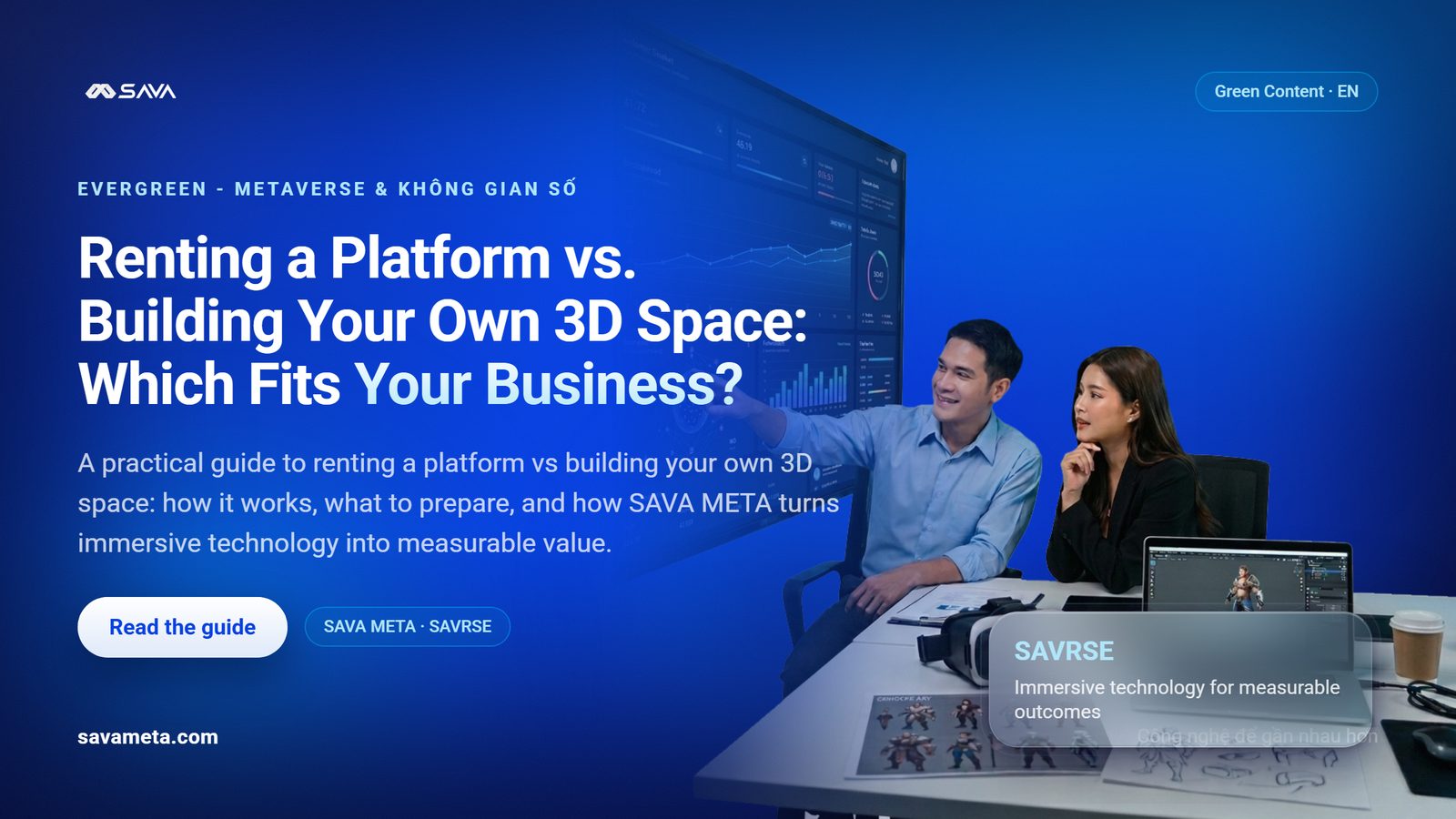
If you are weighing renting a platform vs building your own 3D space, the short answer is this: rent when you need to launch fast, test an idea, or run a one-off event, and build when the 3D space is core to how your product works and needs to fit your data, brand, and roadmap for years. Most businesses do not need to pick a side forever. They need to know which option fits the specific problem in front of them right now, and how much that choice will cost them later. This article walks through both paths, the trade-offs that actually matter, and how to decide without guessing.
A 3D space for business is an interactive, navigable digital environment — a virtual showroom, training room, event hall, or product configurator — that people enter through a browser, headset, or app to do something specific. It is not a game and not a marketing gimmick; it is a place where a real task happens, such as inspecting a product, running a workshop, walking a client through a factory that has not been built yet, or letting a team practice a procedure that is too expensive or dangerous to rehearse in the real world.
The distinction between renting a platform vs building your own 3D space is really a distinction between using someone else’s environment and rules versus owning the environment and its rules. A rented platform gives you a ready-made world you furnish and brand. A custom-built space is software you own, shaped around your process. Both can look impressive to a first-time visitor. The difference shows up months later, when you want to change something, connect it to another system, or scale it.
Renting makes sense when speed, low upfront cost, and low commitment matter more than control. If your goal is to be live in weeks, validate whether your audience even wants a 3D experience, or run an event that ends on a fixed date, a rented platform is usually the grounded choice.
The honest trade-off: you are renting, so you live inside the platform’s limits. You get their feature set, their performance, their branding boundaries, and their pricing changes. If they raise prices, sunset a feature, or shut down, your space goes with them. Your content and audience data may be hard to move. For a short campaign, that risk is small. For a core business function, it grows every month.

Building your own space makes sense when the 3D environment is central to your product or operation and needs to fit systems, data, and workflows that off-the-shelf tools were never designed for. If the experience is a durable asset rather than a temporary campaign, ownership starts to pay off.
The honest trade-off: building costs more upfront, takes longer, and makes you responsible for hosting, updates, security, and support. That responsibility is the price of control. It is worth paying when the space is load-bearing for your business, and wasteful when it is a one-time flourish.
The clearest way to compare is on the dimensions that change your cost and risk over time, not just the demo on day one. The table below lays out where each path is strong.
|
Dimension |
Renting a platform |
Building your own 3D space |
|
Time to launch |
Fast — days to weeks |
Slower — weeks to months |
|
Upfront cost |
Low; subscription-based |
Higher; a project investment |
|
Long-term cost |
Recurring fees that can rise; grows with usage |
Higher at first, more predictable as an owned asset |
|
Control & customization |
Limited to the platform’s options |
Full — shaped to your needs |
|
Integration depth |
Whatever the platform allows |
As deep as you build |
|
Data ownership |
Shared with the vendor’s terms |
Yours to define |
|
Maintenance burden |
Handled by the vendor |
Yours (or your partner’s) |
|
Risk if vendor changes |
High — you depend on them |
Low — you own it |
|
Best fit |
Events, tests, standard use cases |
Core, long-term, integrated experiences |
Notice that neither column is “the winner.” Renting wins on speed and low commitment; building wins on control and durability. The right answer depends on which of those your problem cares about most.

Start by naming the problem the 3D space solves, not the technology you want to use. The decision gets much easier once you can answer a handful of plain questions honestly.
A useful middle path exists too: rent first to validate, then build once you have evidence and clear requirements. The pilot pays for itself by removing guesswork from the build.
It is not the right time to build — or sometimes to do 3D at all — when you cannot yet describe the problem in one sentence or the outcome you would measure. Spending on a custom space before you understand the use case is how projects become expensive experiments no one uses.
In these cases the responsible move is to slow down: run a small rented pilot, gather evidence, and let the results decide whether to build.
SAVA META approaches renting a platform vs building your own 3D space as a business decision first and a technology decision second. We do not start by recommending a build because we build things; we start by asking what problem the space solves, how long it needs to last, and what it must connect to. If a rented platform genuinely fits your event or test, we will say so — pushing a custom build you do not need is not a solution, it is waste.
When building is the right call, our work spans Metaverse and interactive digital space, VR/XR, and AI solutions, so the 3D environment is designed around your process rather than a template. We favor a grounded sequence: define the problem and success metric, prototype the core experience quickly, validate it with real users, then invest in the full build and the integrations that make it useful — CRM, product data, identity, analytics. The aim is an owned asset that fits your roadmap, not a showpiece that impresses once and then sits idle. Where a hybrid makes sense — rent to prove demand, build to scale — we will plan that path with you instead of forcing an all-or-nothing choice.
The most common mistake is choosing the technology before defining the problem, which leads to spaces that look good and do little. A few others show up again and again.

You measure a 3D space the same way you measure any business tool: against the job it was hired to do, with numbers you set before launch. Vanity metrics like total visits mean little on their own.
Not over time. Renting is cheaper to start because you pay a subscription instead of a project cost. But recurring fees add up, and they can rise or scale with usage. For a short campaign, renting is usually cheaper overall. For a core experience you run for years, an owned build often becomes the more predictable cost. Compare total cost of ownership over the real time horizon, not just the first invoice.
Yes, and it is often the smartest path. Renting lets you validate demand and learn what users actually need with low risk. Those lessons become clear requirements for a custom build, which reduces waste and rework. The main thing to check before you rent is how easily you can export your content and data when you move.
You lose control and take on dependency. You work within the platform’s features, performance, branding limits, and pricing, and you rely on the vendor to keep running and supporting it. If they change direction, raise prices, or shut down, your space and sometimes your data are affected. For a temporary use, that risk is minor; for a core function, it is worth weighing carefully.
It depends on scope, but a focused first version — the core experience without every feature — is typically a matter of weeks to a few months, while a fully integrated platform takes longer. Building the core first and expanding after launch is faster and safer than trying to ship everything at once.
No. Many business 3D spaces run in a standard web browser on a laptop or phone, which keeps them accessible to the widest audience. Headsets add value for training, simulation, and design review where a sense of scale and presence matters, but they should be a deliberate choice driven by the use case, not a default.
Building usually fits better when the experience must be unmistakably yours and consistent with your brand down to the details. Rented platforms let you brand within their boundaries, which is fine for events, but a custom space gives you full control over look, feel, and interaction — worth it when the experience is central to how customers perceive you.
Still unsure which side of renting a platform vs building your own 3D space fits your situation? The right answer comes from your specific problem, timeline, and systems — not from a generic rule. SAVA META can help you frame the decision, run a low-risk pilot if that is the sensible first step, and build an owned 3D space when ownership genuinely pays off. Tell us the problem you are trying to solve and we will map the practical options with you. Reach us at [email protected] to start the conversation.
Bài viết liên quan