


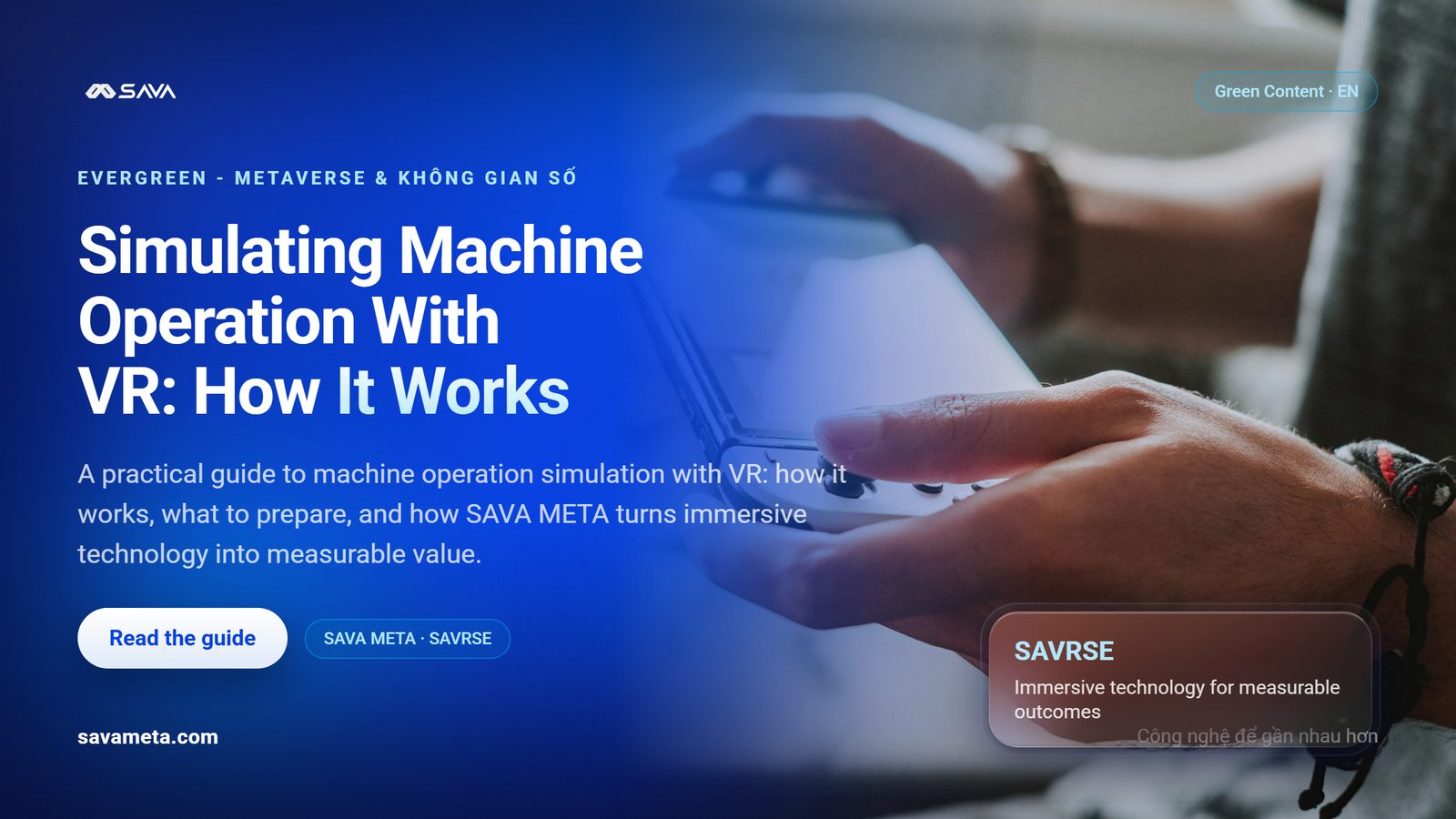
Machine operation simulation with VR works by rebuilding a real machine — its controls, its physics, its failure modes — as an interactive 3D model that a trainee operates through a headset and hand controllers, so the person learns the sequence and the consequences without touching the physical equipment. The system tracks what the operator does, responds the way the real machine would, and records the session for review. In practice, this means a new hire can start a press, a crane, a CNC mill, or an excavator dozens of times, make mistakes safely, and build muscle memory before they are ever handed the real controls. The rest of this article explains what that involves, when it earns its cost, and where it does not.
Machine operation simulation with VR is a virtual-reality training environment that reproduces a specific machine and its operating procedure closely enough that a trainee practices the real task inside it. It is not a video, and it is not a generic “safety experience.” The operator stands in front of a modeled control panel, grabs the same levers, reads the same gauges, and works through the same start-up, running, and shut-down steps they would on the shop floor. The simulation applies rules — load limits, pressure curves, interlocks, timing — so that a wrong action produces a wrong result the operator can see and feel.
Two things make it training rather than a demo. First, fidelity of behavior: the machine reacts correctly, including when the operator does something unsafe. Second, measurement: the system knows whether each step was done, in what order, and how long it took. Without both, you have a visualization. With both, you have a place to practice.
Because the three usual options each leave a gap, and VR sits in the middle of them. A manual explains the sequence but never tests whether the person can perform it under pressure. A video shows an expert doing it right but never lets the trainee do it wrong and learn from that. The real machine teaches best of all — but every hour a trainee spends on it is an hour it is not producing, a risk of damage, and, for dangerous equipment, a genuine safety exposure.
VR fills the gap between “read about it” and “do it for real.” A trainee can repeat a difficult start-up procedure twenty times in an afternoon. They can trigger a fault — an overheating motor, a jammed feed, a dropped load — that you would never deliberately cause on a live machine. And several trainees can practice at once on identical virtual copies, instead of queuing for the single physical unit. The value is highest exactly where the real machine is expensive, scarce, dangerous, or in constant production use.
Building a useful machine operation simulation with VR is mostly engineering discipline, not visual polish. The work breaks into a clear sequence:
The heaviest work is usually the behavior layer and the validation. A pretty model that reacts wrong teaches the wrong thing, which is worse than no simulator at all.
Start with one machine, one procedure, and one measurable pain. Do not try to simulate an entire facility on the first attempt. Pick the single task where poor training already costs you the most — the machine that gets damaged by new operators, the procedure with the worst safety record, or the equipment that creates the longest onboarding delay.
A practical first-project checklist:
A tightly scoped first simulation proves the value, produces numbers you can defend, and becomes the template for the next machine.
VR is the wrong first move when the underlying procedure is not yet settled, or when the problem is not really a training problem. If your operators fail because the written procedure is unclear, the machine itself is poorly maintained, or shifts are understaffed, a simulator will faithfully reproduce a broken situation and change nothing.
Hold off, or fix the root cause first, when:
Being honest about this protects the budget and the credibility of the project. A simulator built on an unstable procedure becomes shelfware.
You measure it against the pain you chose at the start, not against how impressive the demo looks. The point of machine operation simulation with VR is a change in a real number, and you should agree on that number before building anything.
Signals worth tracking include:
The strongest evidence pairs an in-simulation improvement with a change on the real machine. Rising sim scores that do not show up in scrap or incident data are a warning that the simulation does not match reality closely enough.
The most common failure is spending the budget on visuals and starving the behavior. Teams fall for a beautiful model that reacts wrong, and operators quietly stop trusting it. Other recurring mistakes:
The table below is a rough guide, not a verdict — the right choice depends on the machine and the risk.
|
Method |
Safe to fail |
Repeatable at scale |
Behavioral realism |
Best for |
|
Manual / classroom |
Yes |
Yes |
None |
Explaining theory and sequence |
|
Video |
Yes |
Yes |
Low (watch only) |
Showing correct technique once |
|
VR simulation |
Yes |
Yes |
High, if built well |
Practicing operation and faults safely |
|
Real machine |
No |
Limited |
Complete |
Final sign-off and real conditions |
VR does not replace the real machine for final certification. It replaces the risky, expensive early repetitions, so that when the trainee reaches the real equipment they are already competent at the sequence and calm under fault conditions.
SAVA META starts from the training problem, not the headset. Before modeling anything, we work with your operators to capture the real procedure and the ways it fails, and we agree with you on the single number the project has to move — time to competence, scrap rate, or incident count. That number scopes the build and judges it later.
From there our priority order is deliberate: behavior first, measurement second, visuals last. We invest in a machine that reacts correctly — including under fault conditions — and in scoring that shows whether trainees are actually improving, before we spend on visual detail beyond what the task needs. We validate with your expert operators until they agree the simulation behaves like the real equipment, because a simulator they do not trust is a simulator nobody uses.
As a company working across Metaverse and interactive digital space, VR/XR, game technology, and AI, we treat a machine simulator as a product with a job, not a showpiece. We would rather ship one tightly scoped simulator that measurably shortens onboarding on your hardest machine than a broad, shallow experience that photographs well and teaches little. If VR is not the right tool for your situation yet, we will tell you that too.
No. Standalone consumer-grade VR headsets are enough for most machine operation training, and you can start with a small number to validate the first simulation. Hardware is a minor line item next to the work of capturing the procedure and building correct machine behavior. Buy for the training goal you have defined, not the other way around.
It has to be accurate in behavior, not necessarily in appearance. Control placement, the operating sequence, machine response, limits, and fault behavior must match reality closely enough that skills transfer. Photorealistic surfaces matter far less than a machine that reacts the way the real one does when the operator makes a mistake.
Yes, and this is one of the strongest reasons to use it. A VR simulation lets operators practice responding to overloads, jams, dropped loads, and emergency stops as often as needed, with zero physical risk. Rehearsing failures is usually impossible or reckless on the real machine, which is exactly where safe simulation earns its place.
No. It replaces the early, repetitive, higher-risk practice and shortens the time a trainee needs on live equipment. Final sign-off should still happen on the real machine under real conditions. Think of VR as the stage that makes the real-machine time shorter, safer, and more productive.
It depends on the complexity of the machine and how well the procedure is documented, but a tightly scoped single-task simulation is a bounded project, not an open-ended program. The biggest variable is availability of expert operators to define and validate correct behavior. Narrow scope keeps the first build predictable.
The simulation has to change with it, which is why we treat it as a maintained product rather than a one-off. Plan for updates when controls, limits, or steps change, so the simulator never teaches an outdated procedure. Building the behavior layer cleanly from the start makes these updates far cheaper.
If you have a machine where new operators are slow to train, costly to get wrong, or exposed to real risk, that is the place to test this approach. Bring us the one procedure that hurts most, and we will help you decide honestly whether machine operation simulation with VR is the right fix — and if it is, scope a first simulator around a number that matters. Talk to SAVA META at [email protected].
Bài viết liên quan