


The main benefits of VR training are faster skill retention, safer practice of high-risk tasks, lower long-term cost per trainee, and measurable performance data you can act on. Instead of reading a manual or watching a video, people practice the actual job in a realistic simulation until the right actions become muscle memory. For businesses that train people on dangerous, expensive, or hard-to-repeat scenarios, the benefits of VR training show up where it matters: fewer mistakes on the floor, shorter ramp-up time, and consistent standards across every location. This article explains what VR training is, when it earns its keep, when it does not, and how to judge whether it fits your business.
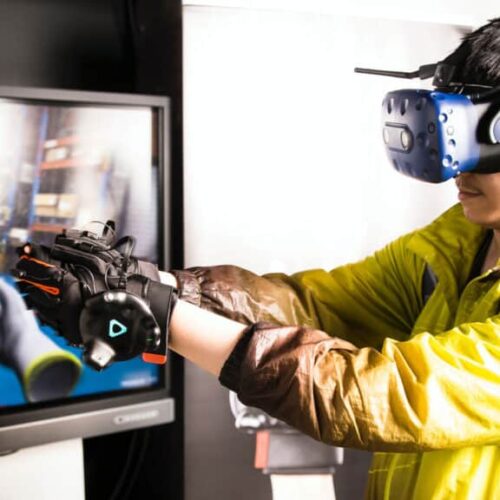
VR training is a learning method where employees complete job tasks inside a computer-generated 3D environment using a headset, so they practice by doing rather than by watching. The learner moves, looks around, picks up tools, and makes decisions in a space that responds like the real one. A warehouse worker can rehearse a forklift route, a technician can strip down a machine, or a customer-facing team can handle a difficult conversation, all without touching real equipment or real customers.
The core idea is repetition without consequence. In the physical world, a mistake during training might damage a machine, injure someone, or halt a production line. In VR, the same mistake becomes a teaching moment you can repeat as many times as needed. The environment can also record every action, which turns training from a box-ticking exercise into something you can measure.
VR training tends to stick better because people remember what they physically do far longer than what they passively watch. A video shows the correct steps; VR forces the learner to perform them, in order, under conditions close to the real job. That difference matters most for procedural and physical skills.
This does not mean video and written material are useless. They are cheaper and better for explaining concepts, policies, and background knowledge. VR earns its place specifically where doing the task is the point.

VR training pays off most when the real-world alternative is dangerous, expensive, or difficult to arrange. If a task is cheap and safe to practice for real, VR is often overkill. The value grows as the risk and cost of hands-on practice grow.
VR training is the wrong first move when the task is simple, purely knowledge-based, or changes constantly. Buying headsets before you have a clear, repeatable problem usually leads to expensive hardware gathering dust. It helps to be honest about fit before committing budget.
None of this rules out VR later. It simply means the problem should lead, and the technology should follow.
A VR training program is less about the headset and more about the content, the rollout, and the measurement around it. The hardware is the easy part. The work sits in turning a real job into an accurate, teachable simulation and getting it into people’s hands reliably.
You measure VR training the same way you would measure any training investment: against a business outcome, not against how impressive the demo looked. The advantage is that VR records behaviour, so you have richer data than a paper test can give you. Decide your metrics before you build, then track them.
The last point is where VR often turns a corner. The build cost is front-loaded, but once the scenario exists, each additional trainee is cheap. The more people run through it, the better the economics look compared with instructor-led sessions that cost the same every time.
No single method wins everywhere. The table below sums up where each approach is strongest so you can match the method to the task rather than forcing one everywhere.
|
Factor |
VR training |
Classroom / instructor |
Video / e-learning |
|
Best for |
Physical and high-risk practice |
Discussion, nuance, live coaching |
Facts, policy, background knowledge |
|
Upfront cost |
High (content + hardware) |
Low to medium |
Low |
|
Cost per extra trainee |
Low once built |
High (repeats every session) |
Very low |
|
Safety of practice |
Practise failure with zero real risk |
Limited by real conditions |
No hands-on practice |
|
Consistency across sites |
Identical every time |
Varies by instructor |
Identical every time |
|
Data captured |
Detailed behaviour logs |
Instructor judgement |
Quiz scores only |
The most common mistake is buying the technology before defining the problem. When the headset arrives first and the plan comes later, adoption is weak and the return is hard to prove. A few recurring traps are worth avoiding.
SAVA META treats VR training as a business problem first and a technology project second. Before proposing a headset or a scenario, we want to understand the task you are struggling to train, who has to learn it, and what a good outcome looks like in numbers. If the honest answer is that a document or a short video would do the job, we will say so. VR is worth building when the real-world practice is genuinely risky, costly, or hard to repeat, and that is where we focus.
Our work sits across Metaverse and interactive digital space, VR and XR, so we build the simulation around your actual procedure, not a generic template. We start by capturing how the job is really done, including the mistakes people make, then design a scenario with clear pass criteria and built-in measurement. We push for a small pilot before any wide rollout, because watching real users struggle is the fastest way to find what needs fixing. We also plan the unglamorous parts, hardware logistics, hygiene, updates, so the program keeps running after launch instead of stalling in month two.
The goal is not an impressive demo. It is a repeatable training asset that shortens ramp-up time, reduces errors, and gives you data you can defend to a budget owner. If VR is not the right tool for your problem yet, we would rather tell you early than sell you hardware you will not use.
Cost depends on scenario complexity, the number of headsets, and how much custom 3D content is required. The largest expense is usually building the simulation, which is front-loaded. Because that content is reused for every trainee, the cost per person falls as more people go through the program, which is why VR often suits larger or ongoing training needs.
Yes. VR is used to rehearse difficult conversations, customer de-escalation, interviews, and sales objection handling. It gives learners a consistent practice partner and a safe space to fail, which is hard to arrange with live role-play. The benefit is repeatability: everyone practices the same scenario to the same standard.
Some people are sensitive to VR motion, but good scenario design reduces this significantly by limiting artificial movement and keeping sessions short. Modern headsets are also more comfortable than earlier generations. A pilot helps you spot comfort issues early and adjust the design before a full rollout.
A focused single-task scenario is faster to build than a full multi-branch program. Timelines depend on how well the procedure is documented and how much bespoke environment modelling is needed. Capturing the real procedure accurately at the start is what keeps the build efficient and avoids costly rework later.
No, and it should not try to. VR is strongest for physical and high-risk practice. Facts, policies, and background knowledge are usually cheaper to teach with documents or e-learning, and some coaching is best done live. The right approach blends methods and uses VR only where practising the task is the point.
Record a baseline before you start, then track outcomes such as time to competency, error rates, and incident counts after training. VR also logs in-simulation behaviour, giving you data a paper test cannot. Deciding your metrics before you build is the single most important step for proving return.
If you have a training problem where real-world practice is risky, costly, or hard to arrange, VR may be worth exploring, and it may not. The right way to find out is to look at the specific task, the people, and the numbers before spending on hardware. If you would like a grounded assessment of whether VR training fits your situation, talk to the SAVA META team at [email protected]. We will help you decide where it earns its keep and where a simpler method would serve you better.
Bài viết liên quan