


VR training for business is the practice of teaching employees a skill by having them do it inside a realistic virtual simulation, on a headset, before they ever face the real situation. It earns its place when the real thing is expensive to stage, risky to get wrong, or hard to repeat often enough for people to get good at it — a machine you cannot stop for practice, a safety incident you cannot rehearse for real, a customer conversation that only happens once. This guide is about deciding whether VR training for business fits your problem, what a serious programme actually involves, and how to measure whether it worked, without buying headsets first and finding a use later.
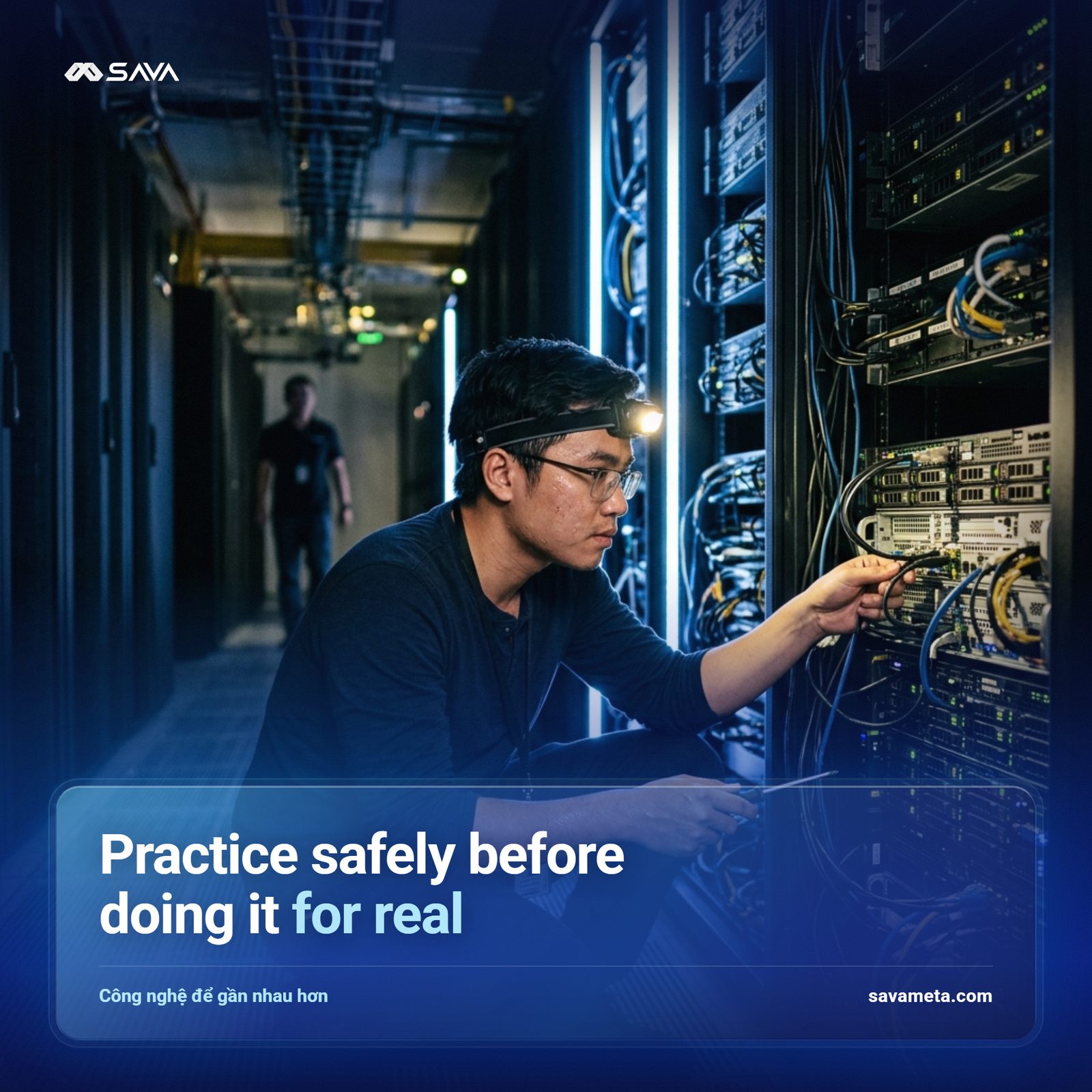
VR training for business is workplace learning delivered through an interactive virtual-reality simulation, where an employee wears a headset and practises a task in a computer-generated environment that responds to what they do. Instead of watching a video or reading a manual, the trainee moves, handles tools, makes decisions, and lives with the consequences inside a safe copy of the real setting. The point is not the headset — it is the practice. VR is simply the medium that lets someone rehearse a physical or high-stakes procedure as many times as they need, without the cost, danger, or scheduling of doing it for real.
It helps to separate three things that often get blurred. A 360 video puts a trainee inside a filmed scene they watch but cannot change. An interactive VR simulation lets them act, and the scenario reacts — this is where real skill-building happens. A multi-user virtual space adds other people, so a team can train together or a trainer can guide from inside. Most businesses that succeed with VR training start with focused interactive simulations for one high-value task, not an open-ended world.
It solves the gap between knowing something and being able to do it under pressure. Manuals, slides, and classroom sessions transfer information well, but they cannot give someone the muscle memory and calm that come only from having done the task before. When the cost of a first-time mistake is high — an injury, a damaged machine, a lost customer, a failed audit — that gap is exactly where traditional training falls short. VR closes it by turning “you have been told how” into “you have already done it, several times.”
Concretely, the value of VR training for business tends to show up as:
The businesses that benefit most are the ones where practising the real task is costly, risky, rare, or disruptive. If your training is mostly knowledge that a good document or short video can carry, VR is overkill. The fit is strongest when at least one of these is true:
Start with one high-value task and one group of people, not with a headset order. The most common way to waste money on VR training for business is to buy hardware because it looks forward-thinking, then hunt for something to train. Instead, name the single task where poor performance costs you the most — in safety incidents, scrap, rework, failed onboarding, or lost customers — and build the smallest simulation that lets people rehearse exactly that.
A sensible starting sequence looks like this:
It is not the right time when you cannot name the task, the audience, or the number the training should move. If VR is on the table mainly because a competitor announced a programme, or because it would look modern to the board, that is a warning sign, not a brief. Hold off, or start smaller, when any of the following is true:
Naming these honestly saves money. A VR programme that nobody maintains, or that trains an obsolete procedure, does more harm than a plain but current classroom session.
The process is a production pipeline closer to making an interactive product than recording a course. Understanding the stages helps you budget time and avoid surprises. A typical build moves through:
|
Stage |
What happens |
Who is involved |
|
Discovery |
Define the task, audience, success metric, and how competence will be judged |
Your team + learning strategist |
|
Scenario design |
Break the task into steps, decisions, and failure points to simulate |
Subject experts + designers |
|
3D and interaction build |
Model the environment and make it respond to the trainee’s actions |
3D artists + developers |
|
Assessment logic |
Decide what counts as success and what the system records |
Designers + your trainers |
|
Pilot |
Test with a small group, fix confusion, tune difficulty |
Trainees + team |
|
Rollout & measure |
Deploy, manage hardware, track results, iterate |
Everyone |
Two stages quietly decide whether the programme works. Scenario design is where a simulation becomes real training or an expensive gimmick — the value is in capturing the actual decisions and mistakes people make, not just the happy path. And assessment logic is what separates VR training from a novelty: if the system cannot tell you who is competent and who is not, you have bought an experience, not a training tool.
You measure results by tying the simulation to the business outcome you named at the start, not to how impressed people were by the headset. “They enjoyed it” is not a result. The metrics worth tracking depend on your goal:
The most useful output is often the per-step failure data. When the simulation shows that most trainees stumble at the same point, you have learned something about the task itself — insight you can feed back into your real procedures, job aids, and supervision, well beyond the VR programme.
The most common mistake is treating VR training for business as a technology purchase instead of a training programme with a job to do. The others follow from that:
SAVA META starts from the training problem, not the headset. Before designing any simulation, the useful questions are: which task is costing you most when it goes wrong, who performs it, and what number tells us the training moved the needle. We would rather ship one focused simulation that measurably cuts a real error rate than a broad VR “academy” that demos well and changes nothing on the floor.
In practice that means a few grounded commitments:
Because SAVA META works across Metaverse and interactive digital space, VR/XR, game development, and AI, the recommendation is not biased toward one format. The aim is a digital experience that steps into a real business problem — people getting hurt, ramping up too slowly, or making the same costly error — and comes out with a result you can point to.
A video is something you watch; VR training is something you do. In a proper VR simulation the trainee performs the task, makes choices, and experiences the consequences, which builds the muscle memory and judgement that passive media cannot. That active practice is why VR suits physical and high-stakes procedures, while a video remains fine for pure knowledge. If a supplier offers only 360 footage you sit and watch, that is a video, not VR training.
Fewer than most people expect, because a pilot only needs enough to give a small group real practice time. Many programmes start with a handful of headsets shared on a schedule, prove the value on one task, then scale. The bigger question is not how many you buy but who owns them day to day — charging, cleaning, updates, and support decide whether the kit gets used or gathers dust.
The upfront build costs more than making a slide deck, but the right comparison is the cost of the problem you are solving. If a simulation reduces safety incidents, shortens onboarding, and cuts scrap, it is spreading its cost across several expensive problems at once, and the marginal cost of each extra practice run is close to zero. Start with one high-value task, prove the return, then expand — do not commission a full curriculum on faith.
Well-designed training simulations minimise it by favouring stable, standing or seated interactions over fast artificial movement, and by keeping sessions to a sensible length. Discomfort usually comes from poor design choices, not from VR itself. A short pilot with your actual staff is the reliable way to confirm comfort before rolling out more widely, and it also surfaces anyone who needs an alternative.
Yes, if measurement is designed in from the start rather than bolted on later. A serious VR programme records what each trainee did inside the simulation and links it to real outcomes such as incident rates, time-to-competence, or error rates on the job. Insist on this before the build begins; without it you can only prove people used the headset, not that they got better.
A focused single-scenario simulation typically takes several weeks, with the biggest variable being how much environment and interaction must be built precisely versus simplified. Having your procedure documented, your subject experts available, and your success metric agreed is the fastest way to shorten the timeline. A full multi-scenario programme takes longer, which is exactly why starting with one task is the sensible path.
If you can name the one task where mistakes, slow ramp-up, or inconsistency cost you the most, VR training for business is worth a serious look. Bring that single problem to SAVA META at [email protected], and we will tell you honestly whether a VR simulation, a simpler format, or a phased pilot fits your business best.
Bài viết liên quan