


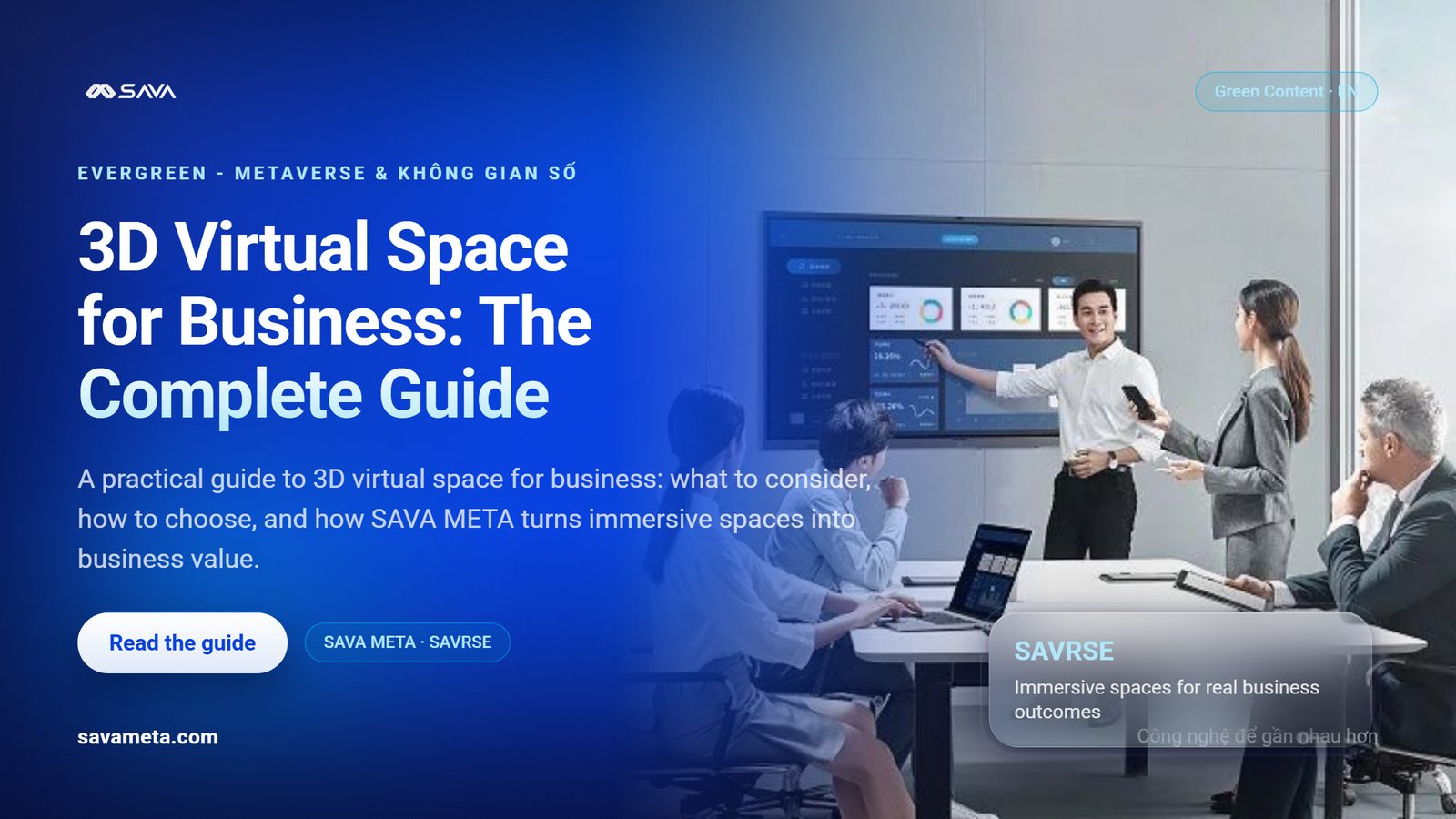
A 3D virtual space for business is a browser- or headset-accessible digital environment where customers, staff, or partners can move, look around, and interact with your products and information in three dimensions — and it earns its place only when a flat page, a PDF, or a video genuinely cannot do the job. If your problem is “people don’t understand our product until they see it in person,” “our showroom can’t scale,” or “training on real equipment is slow and risky,” a 3D virtual space is a practical tool. If your problem is “we want to look modern,” it is not. This guide explains what these spaces actually are, where to start, when to wait, how the build works, how to measure it, and how SAVA META approaches the whole thing.

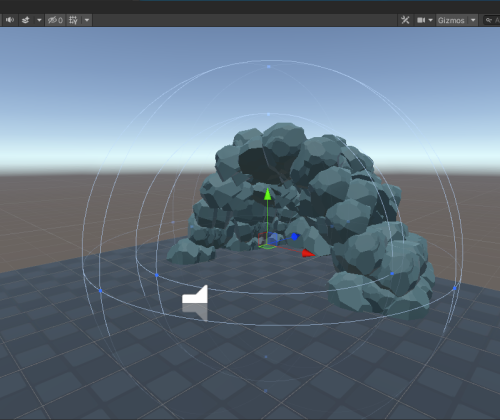
A 3D virtual space for business is an interactive, navigable digital environment that represents a product, place, or process in three dimensions, usually reached through a web link or a VR headset. Unlike a photo gallery or a video, the visitor controls the viewpoint: they walk through a showroom, orbit a machine, open a virtual booth, or step onto a factory floor that would be expensive or impossible to visit in person. The space can hold clickable hotspots, product data, forms, video, and live people represented as avatars.
In plain terms, it sits between a website and a physical location. It carries more spatial and emotional information than a webpage, and it removes the cost, distance, and scheduling of a real venue. That trade-off is the whole point — and it is also the test. If the extra dimension does not change how someone decides, learns, or buys, you are paying for 3D you don’t need.
Start with a single, painful, well-defined use case — not a “metaverse strategy.” The businesses that get value from a 3D virtual space almost always begin with one concrete problem and one audience, then expand only after it works.
Good starting points share a pattern: something is hard to show, hard to reach, or hard to practice on. Ask which of these describe you:
Pick the one where the cost of the current situation is easiest to name in money or time. A virtual showroom that removes 300 km of travel per qualified lead has an obvious case. A “virtual HQ” built because a competitor has one usually does not.
It is not the right time when the underlying content, process, or goal is still unstable — a 3D space will only make the confusion more expensive. Building in three dimensions costs more than a webpage, so the prerequisites matter.
Hold off if any of these are true:
None of these are permanent blockers. They are signals to fix the fundamentals first — clarify the offer, sort out the assets, confirm the audience’s devices — so the 3D investment lands on solid ground instead of papering over a gap.
The process is less about 3D artistry and more about disciplined scoping: define the outcome, gather or create assets, build a small version, test with real users, then harden and launch. Skipping the early steps is the most common way these projects overrun.
A typical path looks like this:

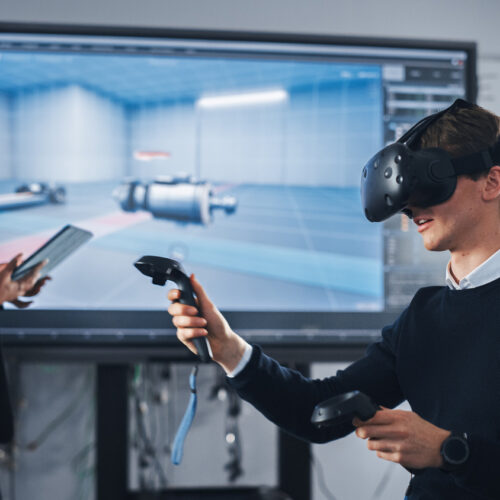
Choose web-based 3D when reach and low friction matter most, and headset VR when depth of experience and hands-on practice justify a smaller, more committed audience. Most business use cases start on the web because a link that opens in any browser removes the biggest barrier: needing hardware.
| Factor | Web-based 3D (browser) | Headset VR |
| Access | Any link, phone or desktop | Requires a VR headset |
| Audience reach | Broad — customers, public, prospects | Narrow — staff, trainees, events |
| Best for | Showrooms, product config, virtual tours, launches | Skills training, safety simulation, deep design review |
| Sense of presence | Moderate | High |
| Setup friction | Low | Higher — hardware and space needed |
The two are not rivals. A common pattern is a web showroom for the public and a headset training module for staff, sharing the same underlying 3D assets so the second build costs less than the first.

SAVA META starts from the business problem, not the technology — we treat a 3D virtual space as a means to a measurable outcome, and we will say so plainly when a simpler tool would serve you better. Our work spans Metaverse and interactive digital space, VR/XR, game studio and publishing, and AI, which means we can build ambitious environments. It also means we have seen where they are wasted, so we scope hard before we build.
In practice, that approach looks like this:
Our bias is toward products and experiences that step into a real problem — a showroom that shortens a sales cycle, a training space that reduces risk, an event that reaches people who could never attend in person. If your case is strong, we build the ambitious version with confidence. If it is not yet, we would rather tell you than sell you a space you don’t need.
Measure it against the one outcome you defined at the start, using behaviour inside and after the experience — not visit counts alone. A space that gets thousands of views but changes no decisions has failed, however impressive it looks.
Useful metrics depend on the goal, but they tend to fall into these groups:
Set the baseline before launch — the current cost, time, or conversion rate — so the 3D space is compared against reality, not against zero.
The most common mistake is building a 3D virtual space to impress rather than to solve, which produces something beautiful that nobody needs to return to. The rest usually follow from that first error.
No. Most business-facing 3D spaces are web-based and open in an ordinary browser on a phone, tablet, or computer. Headsets are used for specific cases like immersive training or design review, where the depth of experience justifies the extra hardware. Choosing web first keeps your audience as large as possible.
A focused prototype — one room or one product flow — can be ready in a few weeks, while a full, polished environment takes longer depending on how many assets must be created and how complex the interactions are. The biggest variable is not the 3D work itself but how ready your content, product data, and goals are before the build starts.
Not exactly. “Metaverse” usually implies persistent, shared, multi-user worlds. A 3D virtual space for business can be that, but it can also be a single-user showroom or tour with no social layer at all. Start with the experience your problem needs; a shared, persistent world is one option, not a requirement.
Whatever already represents your product or place: CAD files, product models, floor plans, photos, brand guidelines, and accurate product data. The more usable material exists, the faster and cheaper the build, because less has to be modelled or scanned from scratch. Where assets are missing, they can be created, but that adds time and cost.
Yes, if it is engineered for it. Web-based 3D can run well on phones when load times, model complexity, and rendering are optimised for real devices from the start. Performance problems almost always come from building for a demo machine and testing on mobile too late.
Define the outcome and baseline first. If you can name a current cost — travel, slow onboarding, lost leads from customers who can’t visit — and show that a 3D space measurably reduces it, the investment is justified. If you cannot name that cost, that is a signal to wait rather than to spend.
If you have a concrete problem — a product that’s hard to show, an audience that’s hard to reach, or a task that’s hard to practise safely — a 3D virtual space for business can be a genuinely useful tool. If you’re not sure whether your case is strong enough yet, that is exactly the conversation worth having before anyone builds anything. Tell us the problem, and SAVA META will tell you honestly whether 3D is the right answer and, if it is, how to build the version that earns its cost. Reach us at [email protected] to scope your use case.
Bài viết liên quan